 EN


How does copper clad aluminum magnesium wire perform under temperature changes
Copper clad aluminum magnesium wire changes electrically and mechanically as it warms and cools. Its resistance generally rises with temperature; its copper outer layer and aluminum-magnesium core also respond differently to expansion. Whether those changes matter depends on the conductor construction, the temperature history, the connection and the finished cable. A material name alone does not establish an operating temperature range.
For a cable maker, the useful question is not simply whether a wire is heat resistant. It is whether the particular wire, insulation and termination retain the required performance after exposure to the actual process and service conditions. That calls for a documented specification and representative testing.
What changes when the wire heats up?
Most metallic conductors have higher electrical resistance at higher temperatures. Copper clad aluminum magnesium wire combines conducting materials with different properties, so the change for a particular construction should be measured or obtained from its supplier rather than borrowed from a pure-copper table. Copper thickness, alloy composition and drawing history can all influence the result.
For a first approximation over a limited range, engineers often use R(T) = R(T0) × [1 + α(T − T0)], where R(T0) is resistance at the reference temperature and α is the relevant temperature coefficient. This is a calculation model, not a published coefficient for CCAM. Use an experimentally supported coefficient for the actual wire and check that the approximation is valid across the intended range.
Higher conductor resistance can increase resistive heating at a fixed current, since the power dissipated is proportional to current squared times resistance. In service, wire temperature depends on the surrounding assembly, current, cooling and nearby heat sources. Ambient temperature by itself is therefore not the same as conductor temperature. For signal cables, evaluate resistance together with the electrical characteristics relevant to the frequency and cable design.
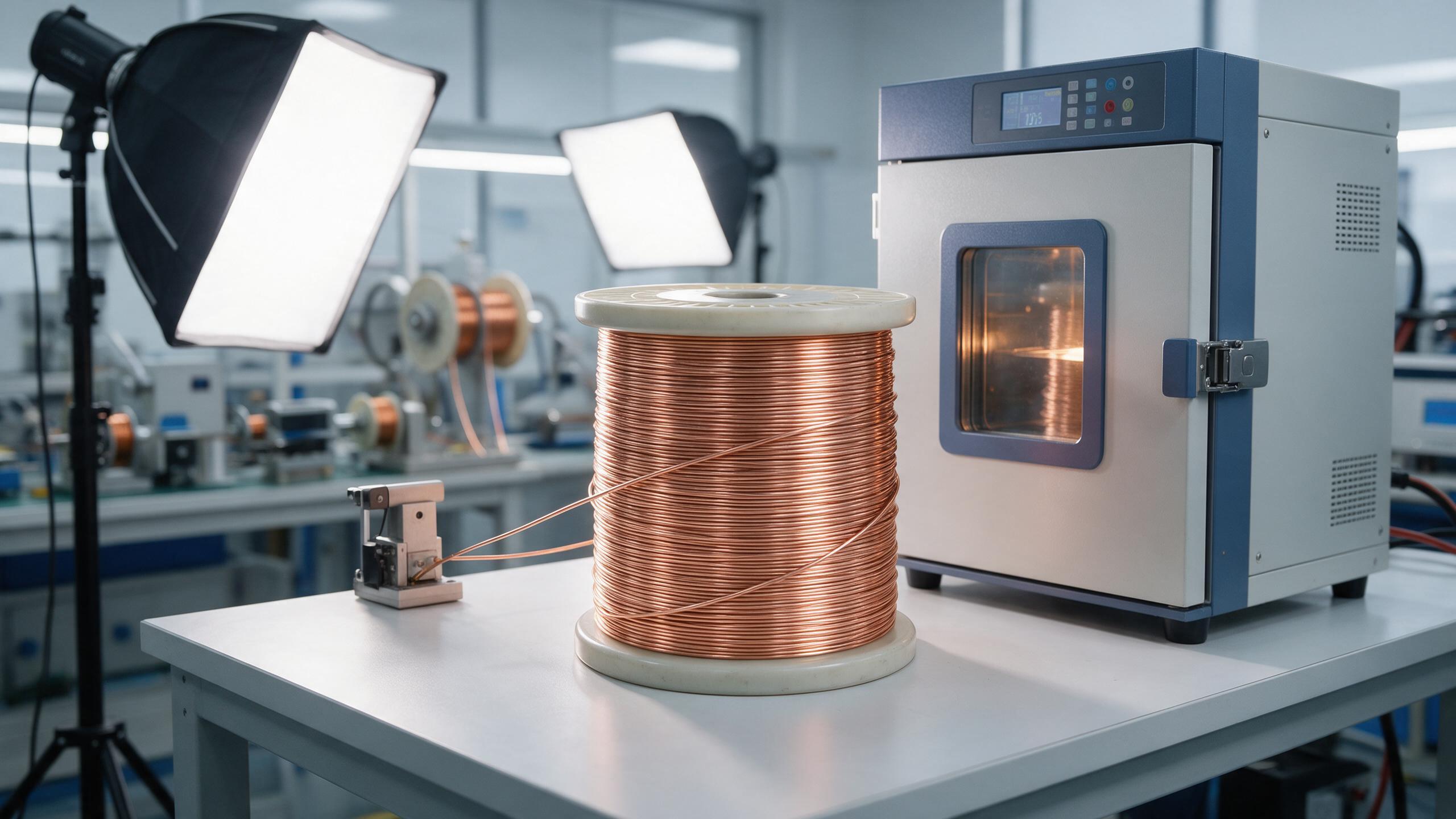
Expansion and cooling: why the bond matters
Copper clad aluminum magnesium wire has a copper exterior and an aluminum-magnesium alloy core. Copper and aluminum alloys do not generally expand by the same amount for a given temperature change. Research on aluminum and its alloys shows that expansion varies with composition and the temperature interval. The response of a bonded composite is not the same as either material expanding freely: geometry, constraint and the quality of the bond matter.
During repeated heating and cooling, movement can also place stress on connectors, bends and insulation. That does not mean every thermal cycle damages the wire. It does mean that a room-temperature check alone cannot establish performance after cycling. A cable assembly with a tight bend near a termination, for example, may deserve different test attention from a straight, unloaded sample.
At low temperatures, contraction and changes in flexibility should be considered across the whole cable, not just the metal. Insulation, jackets and connector components can become less flexible. Confirm the minimum installation temperature separately from the minimum service temperature: bending a cold cable can impose different stresses from leaving an already installed cable in place.
What limits temperature resistance?
The temperature resistance of copper clad aluminum magnesium wire cannot be summarized by a universal maximum temperature. A bare conductor, its bonded boundary, insulation, protective jacket and termination each have their own limitations. Sustained heat exposure can change mechanical properties, while a short processing excursion can have different consequences from years of service. A published rating for another cable construction is not evidence for this one.
Ask the supplier for the applicable product specification, including the test conditions behind any temperature statement. Check whether the stated value refers to ambient air, conductor temperature, installation, storage or processing. If a number is missing, treat it as an open engineering question rather than inferring one from copper or aluminum melting points.
How to evaluate a proposed application
Before selecting copper clad aluminum magnesium wire, define the temperature profile and the performance that must survive it. Separate the incoming conductor from the finished cable and its connectors. A useful qualification plan can cover the following checks.
- Define exposure. Record low and high temperatures, dwell times, transition rates, number of cycles, humidity and any electrical loading. Identify the expected conductor temperature, not only the surrounding air.
- Agree on sample construction. Specify diameter, copper layer, alloy designation if available, temper, insulation and termination. Document which production sample each measurement represents.
- Measure a baseline. Record resistance at a controlled reference temperature and inspect the surface and connections. Compare later readings at the same temperature so reversible temperature effects are not mistaken for permanent change.
- Cycle representative assemblies. Apply the agreed profile to wire and finished terminations. Examine connection resistance, physical condition and any application-specific electrical characteristics before and after exposure.
- Check mechanical and process fit. Agree on suitable tensile, bend, adhesion or other checks with the supplier and testing team. Evaluate installation bends and the actual cable-making process where relevant.
- Set acceptance criteria beforehand. Define measurement method, allowed change, sample size and disposition of failures before testing. Repeat qualification if the construction or intended exposure changes materially.
This sequence does not substitute for the governing cable specification or a qualified engineer's assessment. In a regulated installation, confirm the applicable rules and approved connector compatibility before selecting any conductor. Copper cladding alone does not establish that a termination is suitable for a particular wire.
What should buyers ask a supplier?
When discussing copper clad aluminum magnesium wire with Litong Cable Technology, provide the intended cable application, dimensions, target resistance and the expected thermal profile. Request documentation for the exact construction and a proposed sample plan. Also specify whether the wire will experience heat during drawing, insulation or later assembly, as process exposure can differ from service conditions.
For related context on signal applications and conductor checks, see this discussion of high-conductivity CCAM wire. Its application discussion should not be treated as a temperature rating for another design.
Frequently asked questions
Does resistance return to its original value after cooling?
The reversible temperature-related portion generally falls as the conductor cools. A change measured after returning to the same reference temperature may indicate another effect, such as a changed connection or material condition. Investigate and measure the assembly rather than assuming that the conductor alone is responsible.
Can a copper connector be used without further checks?
Do not assume compatibility from the copper surface alone. Check the connector manufacturer's instructions, applicable requirements and the proposed wire construction. Assess the actual termination before and after the agreed temperature exposure.
Is one thermal-cycle test enough for every use?
No. A meaningful test reflects the temperatures, dwell times, movement, electrical load and service life relevant to the intended assembly. An agreed test result applies to the sample and conditions tested; a different design or exposure may require further qualification.


