 EN


Why is annealed aluminum alloy wire easier to process for cable braiding
Annealed aluminum alloy wire is generally easier to form around a cable because controlled heat treatment can restore ductility lost during drawing. Compared with the same alloy and diameter in a harder, cold-worked condition, it can bend with less resistance and accommodate deformation without breaking as readily. That advantage matters on a braider, where individual wires pass through guides, cross one another and form a layer around a moving cable core. The result is conditional: alloy, temper, wire diameter and machine settings all matter.
For a production team, the useful question is not simply whether a wire is soft. It is whether the chosen wire can unwind, travel through the machine and form the specified braid while still meeting the finished cable's mechanical and electrical requirements. This guide follows that path from material condition to a practical trial.
What annealing changes in drawn wire
Drawing reduces wire diameter by pulling material through dies. The associated cold deformation normally increases strength and hardness while reducing ductility. Annealing applies heat for a controlled period; depending on the alloy, previous work and treatment, recovery or recrystallization can reduce the effects of deformation. Annealed aluminum alloy wire therefore often has lower strength and greater elongation than comparable hard-drawn wire.
One published study examined 5056 aluminum alloy wire after 60% cold deformation. In those specimens, annealing reduced hardness and strength, and the authors reported full recrystallization at 310 °C under their experimental conditions. That result illustrates the mechanism, not a temperature to apply to every order. Another alloy, reduction history, furnace or desired temper can require a different process.
Annealing is not a coating and does not change the wire into another material. Nor does the word alone specify a universal tensile-strength or elongation range. Ask the supplier to identify the alloy, delivered temper and agreed test values for the actual wire.
Why that matters during cable braiding
Repeated bending through the wire path
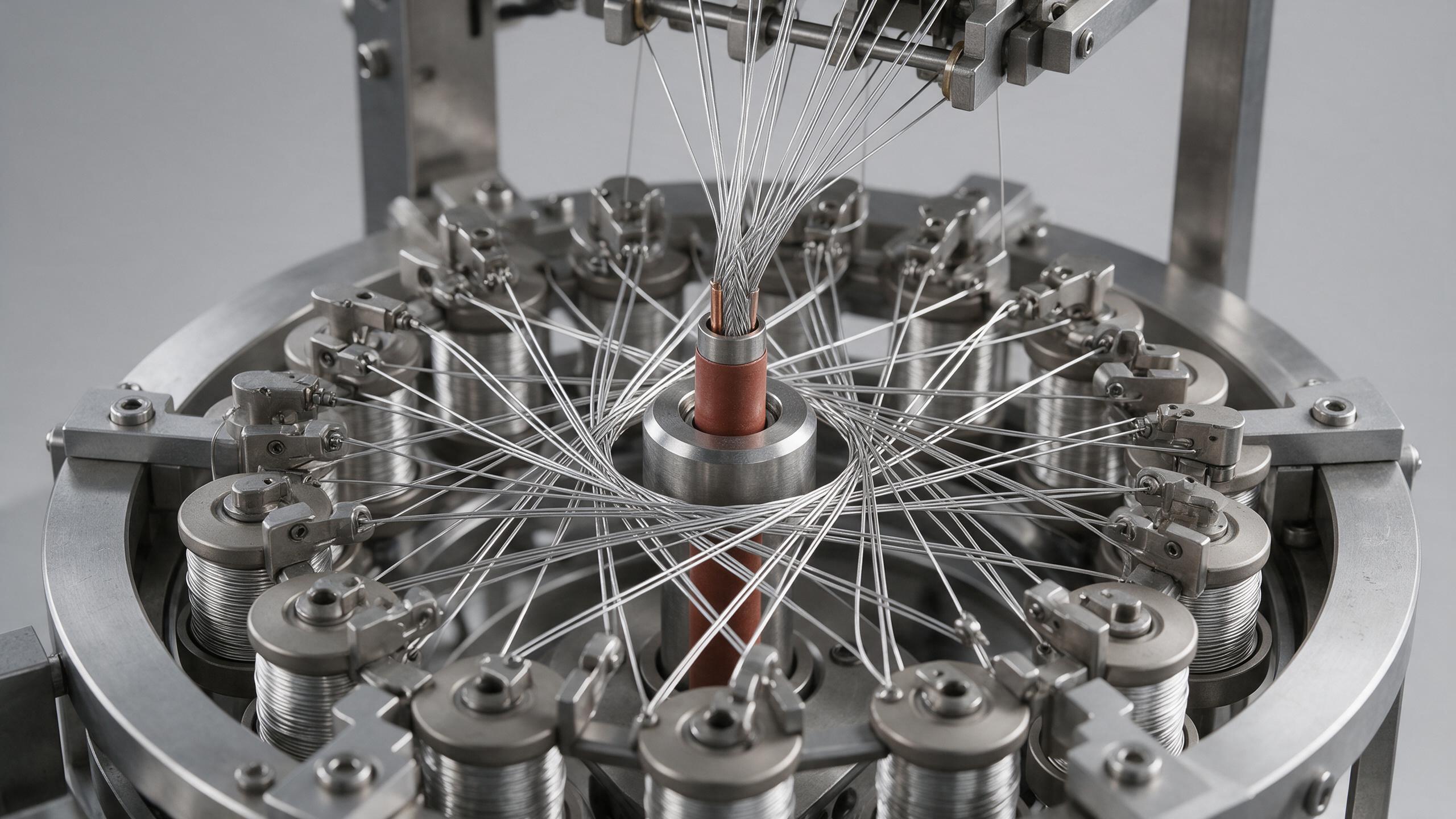
A braiding bobbin holder supplies wire from a bobbin while the wire passes through tensioning components and guide points toward the forming zone. Annealed aluminum alloy wire can conform more readily to that path than the same wire in a harder condition. Greater ductility can help accommodate local bending, especially where guide geometry imposes a small radius. It does not make a damaged guide or an excessively tight bend acceptable.
At the crossing point, each wire must change direction and settle against neighboring wires and the cable surface. A wire with an appropriate temper can be easier to place without forcing it into position. Less bending resistance may also reduce springback, the tendency to return toward the previous shape after forming. Whether that improves the actual braid must be established on the machine.
Pay-off and tension control
Smooth pay-off depends on the bobbin, winding, guide condition and tension system as well as the wire. A more ductile wire can be useful when the path includes frequent directional changes, but low strength creates its own limit. If tension is too high, a soft wire may stretch, thin or break. If it is too low, wires may wander or form an uneven braid. Annealed aluminum alloy wire should be assessed within the tension window of the intended machine rather than described as trouble-free.
When a break occurs, record the position, bobbin and running conditions before attributing it to temper. A rough eyelet, an overfilled bobbin, a kink or a sudden tension change can produce a similar symptom. Separate inspection of the wire and its path is more useful than changing several settings at once.
Forming a braid on the cable
Cable braiding combines multiple wires into an interlaced layer around a core. Depending on the cable design, that layer may contribute shielding or mechanical protection. The finished geometry depends on wire diameter, number of ends, braid angle, line speed and bobbin movement. Annealed aluminum alloy wire may make forming easier, but temper alone does not establish coverage or shielding performance.
For an electrical shield, the finished assembly and its connections must be checked against the cable specification. Visible coverage is useful for a process check, yet it is not a substitute for the electrical or electromagnetic tests required by the application. Also distinguish a braided shield from the central conductor: they have different functions and may have different material requirements.
Where a softer temper can create trade-offs
More ductility is not automatically better in every construction. Annealed aluminum alloy wire may have less tensile strength than an equivalent hard-drawn wire, and this can narrow the acceptable tension range. Handling can also mark or deform a soft wire if contact surfaces are rough or bobbins are mishandled. Surface condition and dimensional consistency deserve attention alongside temper.
Electrical behavior, corrosion exposure, joining method and service temperature must also be considered for the intended alloy and cable design. Do not assume that any aluminum alloy is interchangeable with copper, copper-clad material or a different aluminum alloy. A shielding braid that runs smoothly on a machine still needs to meet the customer's service requirements.
Overheating during heat treatment can alter microstructure and properties in undesirable ways. The production recipe belongs with the wire manufacturer; the buyer's role is to agree the delivered properties, review the test method and confirm performance in a representative trial.
How to run a useful braiding trial
Start with a documented reference material and the intended cable core. Use the same nominal dimensions and braid design when comparing candidates; otherwise, a change in the finished braid may be caused by geometry rather than temper. A short sample can identify obvious issues, but choose a trial length that is meaningful for the machine and acceptance plan.
- Check the incoming wire. Confirm alloy designation, diameter and tolerance, temper, tensile and elongation requirements, spool type and surface condition against the agreed specification.
- Inspect the path. Examine bobbins, eyelets and tension devices for burrs, damage or inconsistent winding. Record the baseline machine configuration before starting.
- Run at controlled settings. Record tension settings, line speed, bobbin arrangement and any changes. Adjust one variable at a time where practical, within the machine maker's operating limits.
- Observe the result. Log breaks and their locations, pay-off behavior, visible wire damage and braid appearance. Measure the coverage and dimensions required by the cable specification.
- Verify the finished cable. Conduct the mechanical, electrical and shielding checks applicable to the end use. Agree acceptance limits before using the observations to qualify a supply.
A trial showing fewer interruptions is useful, but it is not proof of a fixed improvement for every machine. Compare observations over a representative run, note the amount of wire processed and retain the same inspection method for each candidate. If the braid looks uneven, inspect both wire consistency and the machine setup before deciding on a cause.
What to include in an inquiry
When discussing annealed aluminum alloy wire with a supplier, provide the intended cable function, wire diameter and tolerance, alloy or permitted options, delivered temper, tensile and elongation limits, spool dimensions and winding requirements. Include target braid construction, processing conditions and required inspection documents. Identify which fields are fixed and which can be discussed after a trial.
Litong Cable Technology Co.,Ltd works in cable materials, including aluminum alloy stranded wire and conductor-related products. A technical inquiry can start with the intended cable and processing requirements; confirm the exact available wire and its documented properties before selection. The practical decision is to balance easy forming with enough strength and the finished cable's performance, then verify that balance on the actual line.


