 EN


How tccam wire balances cost and corrosion resistance for signal transmission wiring solutions
Choosing a conductor for a signal cable starts with a practical question: how much material can a design save without sacrificing the electrical and environmental performance it needs? tccam bare wire offers one possible answer when a lightweight composite conductor and a tin-coated surface fit the cable design. The balance is conditional, not automatic: the finished cable, its connectors, and the installation environment all matter.
For cable manufacturers and purchasing teams, the useful comparison is not simply price per kilogram. Compare the same usable length, construction, signal requirements, and inspection plan. That makes it easier to see whether a lower material quote survives processing, termination, and testing.
What is tccam bare wire?
TCCAM commonly refers to tinned copper-clad aluminum-magnesium wire. The conductor combines an aluminum-magnesium alloy core with copper cladding and an outer tin layer. In this context, “bare” means supplied without an insulating jacket; it does not mean the wire has no metallic coating. Confirm the precise construction with the supplier because names alone do not establish layer dimensions or composition.
In tccam bare wire, the core reduces the amount of copper used compared with a solid copper conductor of the same nominal dimensions. Copper cladding and the tin surface bring their own handling and connection considerations. However, a composite wire is not electrically or mechanically interchangeable with solid copper merely because their diameters match. Request the actual resistance, dimensions, tensile properties, and coating details for the offered construction.
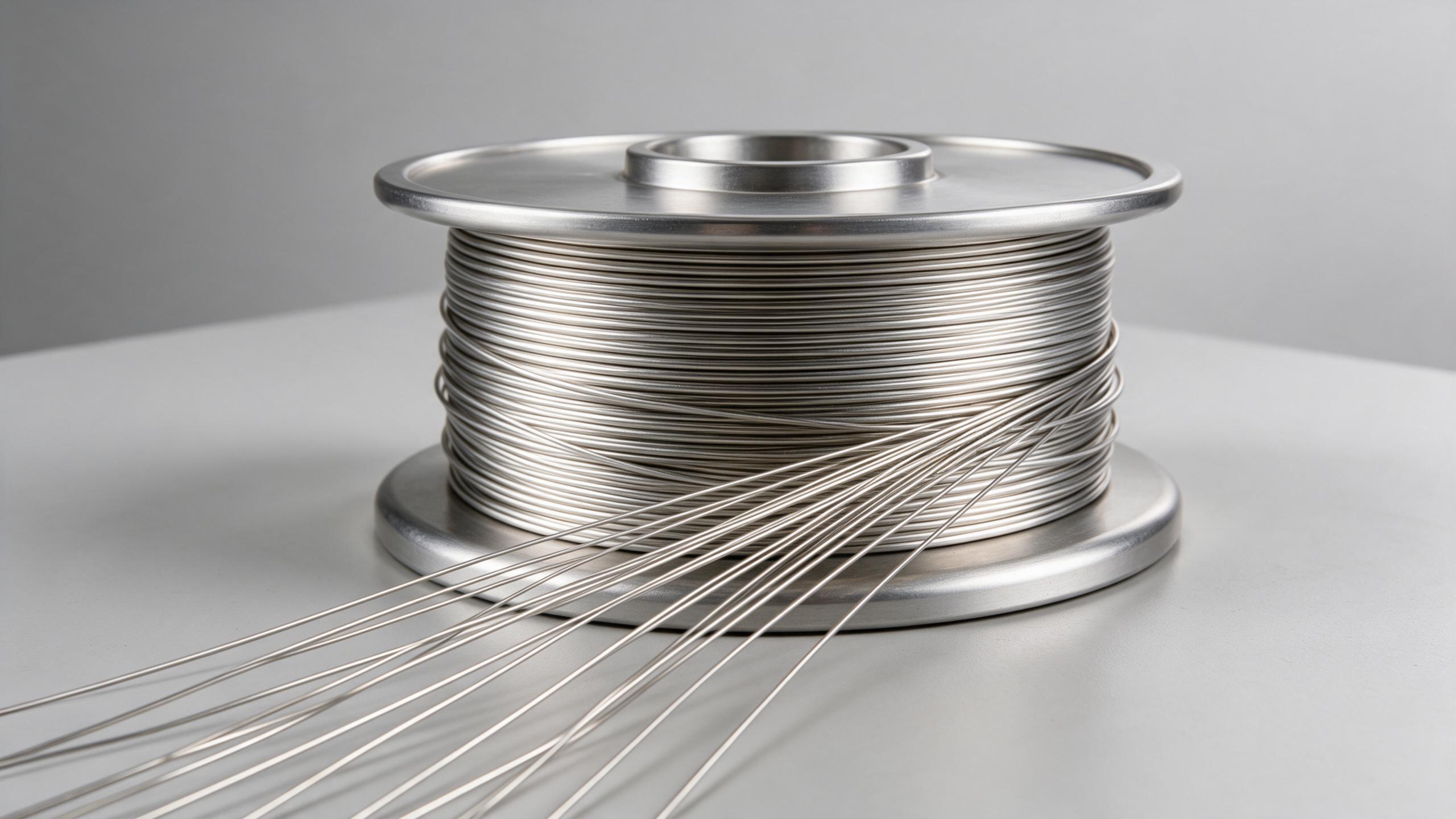
Where the cost trade-off appears
A tccam bare wire quote may be attractive because a lower-density alloy replaces part of the copper. The result depends on metal prices, cladding proportions, processing, order volume, and the quoted unit. A kilogram of one conductor may yield a different length from a kilogram of another. Ask for both mass and length, and compare offers against the same strand diameter and accepted tolerances.
For tccam bare wire, use a simple procurement model: material cost per usable cable length, plus processing losses, inspection costs, and termination costs. For a braid, include the required number of carriers, strand count, coverage, and scrap. For a stranded signal conductor, include strand configuration and the length of finished cable produced. A cheaper reel can be less economical if breakage, machine settings, or rejection rates change; those outcomes must be established by a trial rather than assumed.
When comparing tccam bare wire with solid copper or another clad wire, keep the electrical target fixed. If a design needs a different conductor size, stranding arrangement, or shielding construction to meet the target, include that change in the calculation. This is a comparison framework, not a promise of a particular saving.
Why the tin surface matters for corrosion
In tccam bare wire, tin provides a surface layer between the copper cladding and the surrounding environment. A continuous, suitable coating can support corrosion resistance, particularly where the wire is stored, processed, or used in humid conditions. It is not a sealed enclosure. Scratches, pores, exposed cut ends, unsuitable chemicals, and moisture at a termination can change the result.
The connection deserves as much attention as the wire surface. If dissimilar metals are electrically connected in the presence of an electrolyte, galvanic corrosion can occur. Tin on the outside does not remove every risk at an exposed cut end or poorly matched connector. Check connector compatibility, sealing, surface damage, and the intended moisture or salt exposure together. Tin-plated connections are used to reduce oxidation in some aluminum-to-copper connections, but that general principle is not proof that a particular wire assembly will meet a particular exposure requirement.
For tccam bare wire intended for a demanding environment, ask the supplier to define the test method, sample preparation, exposure duration, and acceptance criteria. Examine the contact area and any exposed ends after the agreed test. A salt-fog result for a loose wire, if available, should not be treated as a substitute for testing a finished termination under the project’s conditions.
Signal transmission depends on the whole cable
In a finished assembly, tccam bare wire can serve different functions in a signal cable. In a braid, it contributes to the shield; in another construction it may be part of the signal path. Those roles need different checks. For shielding, assess braid coverage, construction, continuity, and the finished cable’s shielding performance over the relevant frequency range. For a signal-carrying conductor, review DC resistance, signal loss, impedance, and the complete cable geometry with the design team.
At higher frequencies, current distribution changes with frequency and conductor construction. A copper-clad surface can therefore matter, but there is no universal crossover point or assured loss figure for all tccam bare wire. Measure the finished assembly across the intended bandwidth. If the cable also carries power, confirm current, heating, voltage drop, connector approval, and applicable requirements separately; a signal-use description is not a power-cable approval.
What about flexibility?
A request for tccam flexible wire should describe the finished strand arrangement rather than rely on the word “flexible.” Individual strand diameter, strand count, lay, insulation, bend radius, and movement cycles all affect cable behavior. A tccam flexible wire candidate suitable for a stationary braid may not be suitable for repeated motion. Ask for a bend or flex test on the intended assembly and agree on failure criteria before release.
Compare candidates on a common basis
| Decision point | Question to resolve |
|---|---|
| Cost | What is the delivered cost per usable length after processing and inspection? |
| Electrical fit | Does the finished cable meet resistance, loss, impedance, and shielding targets for its role? |
| Surface protection | What coating checks and exposure tests are agreed, including cut ends and connectors? |
| Processing | Can the proposed wire run through the intended braiding, stranding, and termination steps? |
| Service conditions | What humidity, chemicals, temperature, bend, and movement will the assembly encounter? |
For a deeper discussion of exposure conditions, see Litong Cable’s article on tinned CCAM in coastal environments. The link is to a related editorial resource, not a product specification.
What to include in an RFQ
For a tccam bare wire inquiry, send the intended application and cable role, required diameter and tolerances, strand construction, estimated quantity, and the unit used for comparison. Specify electrical resistance limits and required surface or corrosion tests where known. State the expected storage conditions, processing steps, connector type, and any repeated bending. Identify which items are firm requirements and which still need engineering review.
For tccam flexible wire, ask for a sample, the relevant specification sheet, and a way to trace the sample to the quoted construction. Agree on the measurements, production trial, and acceptance responsibilities before treating a quotation as equivalent to an approved material. Litong Cable Technology Co.,Ltd lists CCAM among its conductor material categories; discuss the actual availability and documentation for the proposed construction directly with the supplier.
In short, tccam bare wire can be worth evaluating when its composite construction and tin surface align with the cable’s cost, signal, and environmental requirements. The decision becomes stronger when the quote, wire tests, finished cable tests, and connector checks all describe the same use case.


